
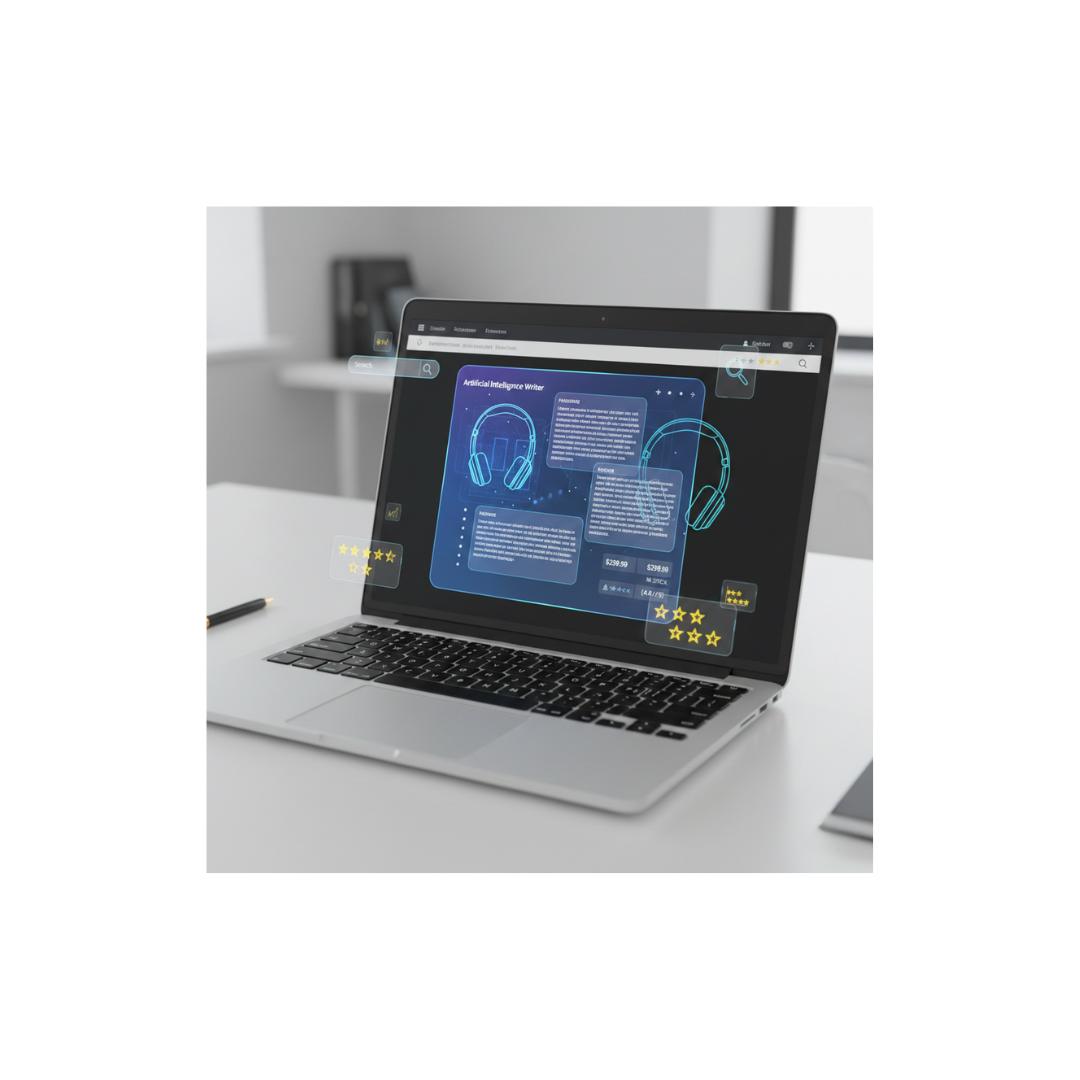
Product descriptions do more than sell. They also determine whether your product pages show up in search results with rich visual elements like star ratings, pricing, availability badges, and featured snippet boxes. Most businesses focus on writing descriptions that sound good but ignore how search engines actually read and display that content.
Here's where AI writing tools genuinely perform well in this space, and where they still need human support.
How Product Pages Earn Rich Results
Rich results appear when Google can clearly understand the structured information on your page. For product pages, this includes:
-
Product name and brand
-
Price and currency
-
Availability status
-
Review ratings and count
-
Product identifiers like GTIN or MPN
This information needs to be present both in the visible page content and in the structured data markup (schema) behind it. When your description includes these details clearly, search engines can pull them into visually prominent search listings that get significantly higher click through rates than plain blue links.
Why AI Tools Handle Structured Content Well
AI writing tools are strong at producing consistently formatted content. When you prompt them correctly, they generate descriptions that naturally include the data points search engines look for.
For example, a well prompted AI tool will include the product name, key specs, material, dimensions, and use case in a predictable structure. This consistency matters when you're publishing hundreds of listings. Human writers naturally vary their approach from one product to the next, which sometimes means key details get buried or left out entirely.
Where an ai product description writer adds real SEO value is in maintaining a uniform content structure across your entire catalog. Google's systems reward pages where information is easy to extract. Consistent formatting across listings helps with that.
Featured Snippets and Product Descriptions
Featured snippets pull short, direct answers from web pages and display them at the top of search results. For product related queries, these often appear as paragraph snippets or bulleted lists.
Queries that trigger product related snippets usually look like:
-
"What is [product type] used for"
-
"Best [product type] for [specific use]"
-
"How does [product type] work"
AI tools can generate description content that directly answers these types of questions within the product page itself. Adding a short "what it does" or "who it's for" section to each listing increases the chance of earning a snippet position for long tail queries related to your product category.
The key is writing those sections as direct answers in two to three sentences, not as marketing fluff. AI handles this format well when prompted to be factual and concise.
Where AI Falls Short With SEO
AI can format content and include relevant terms, but it doesn't understand your specific SEO strategy. It won't know which keywords your competitors rank for, which queries drive your highest converting traffic, or how your internal linking should work.
It also can't write schema markup on its own in most cases. While the visible content might be strong, the technical backend work of adding structured data still requires a developer or an SEO tool that handles schema separately.
Another gap is keyword cannibalization. An ai product description writer will happily target the same search terms across multiple product listings unless you specifically instruct it not to. Without oversight, this creates pages that compete against each other in search results instead of covering distinct queries.
Practical Tips for Getting SEO Value From AI Descriptions
Give precise input data. Feed the tool your product specs, target customer, and primary keyword for each listing. Generic prompts produce generic output that won't rank.
Include question based content. Add a short FAQ or "common questions" block to each product page. AI generates these quickly, and they're strong candidates for featured snippet placement.
Review for duplicate phrasing. Run a check across your catalog to make sure AI hasn't recycled the same sentences across multiple products. Duplicate or near duplicate content hurts your rankings.
Pair AI content with proper schema. The description itself is only half the equation. Make sure your product pages have correct schema markup for price, availability, reviews, and product identifiers.
Don't skip human keyword review. Before publishing, verify that each description targets the right search terms for that specific product. AI doesn't do competitive keyword analysis on its own.
What Actually Moves the Needle
The real SEO advantage of using AI for product descriptions isn't about writing quality. It's about consistency and scale. Stores with large catalogs often have hundreds of pages with thin or missing descriptions. AI fills those gaps quickly, giving search engines something meaningful to index.
Pages with complete, well formatted descriptions and proper structured data consistently outperform pages with one line summaries or manufacturer copy that appears on dozens of other websites.
Conclusion
AI writing tools are genuinely useful for producing product descriptions that align with how search engines read and display content. They maintain consistent structure, include relevant data points, and can generate snippet friendly content at scale. But they don't replace the technical SEO work of adding schema markup, managing keyword targeting across your catalog, or building a broader search strategy. Use AI for the content layer, then apply human oversight for the technical and strategic layers. That combination is where the real results come from.
FAQs
Q.1 Do AI written product descriptions rank well on Google?
They can, if they're well structured, factually accurate, and paired with proper schema markup. Raw AI output without editing or technical SEO support won't automatically rank.
Q.2 What is structured data and why does it matter for product pages?
Structured data is code added to your page that tells search engines exactly what your product details are. It's what enables rich results like star ratings, pricing, and availability badges in search listings.
Q.3 Can AI write FAQ sections for product pages?
Yes, and this is one of its stronger use cases. AI generates concise question and answer pairs quickly, which can help your pages qualify for featured snippet positions on relevant queries.
Q.4 How do I prevent duplicate content across AI generated listings?
Review output across your catalog before publishing. Use plagiarism or similarity checking tools to flag repeated phrases. Adjust prompts to include unique product details that force variation in each description.
Q.5 Should I add schema markup manually or use a plugin?
For most small to mid size stores, a schema plugin or built in platform feature works fine. Larger catalogs with custom requirements may need developer support to implement structured data correctly across all product pages.

 Arabic
 French
 Spanish
 Portuguese
 Deutsch
 Turkish
 Dutch
Dutch
 Italiano
 Russian
 Romaian
 Portuguese (Brazil)
 Greek
Greek